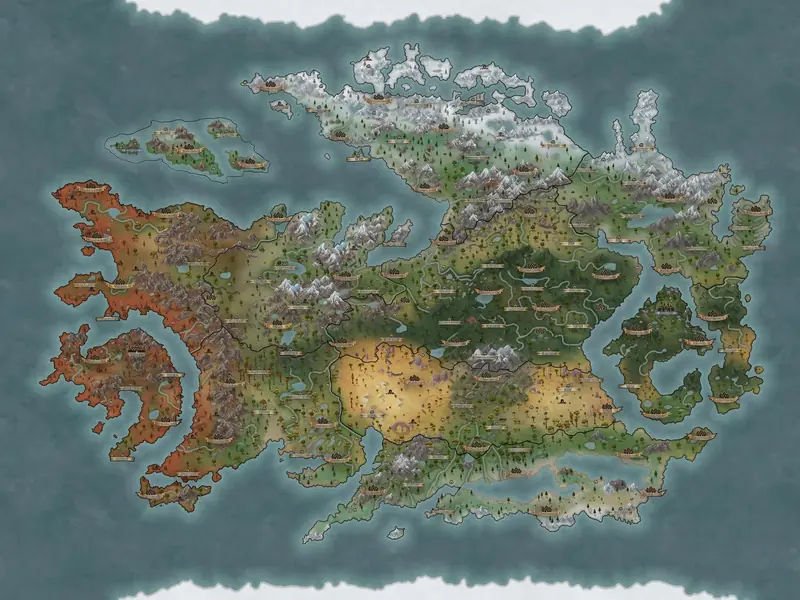
The World of Ethora
An old archive opens. Inside it, the world is still being understood.
The World of Ethora
Ethora is not a young world. The stones beneath the roads were cut before the Arcanus had names for them. The storms that once wandered the continent have quieted, for now. What remains is a single landmass — a continent of forests, deserts, glaciers, and glass-sand coasts — held in a long silence.
It is a world that asks more questions than it answers. Every clearing in the wilds is a small act of courage against a much older wilderness. The Archive does not try to explain it all. It simply points toward the first door.
“Before any Arcanus walked these valleys, older hands had already carved the stones.”
The Judgment Gods

The gods of Ethora do not speak. They do not demand temples or songs. They simply watch — and in watching, they shape the ordinary moments of every Arcanus life.
Hatred, Love, and Life. These are not distant forces. They live inside each Arcanus, tilting slowly with every choice made in a market, a hearth, or a quiet room. A trader who shortens a measure, a parent who shields a child, a stranger who turns away from a wound — each act is felt, recorded, and weighed.
No one knows what the gods truly want. The scholars argue. The priests disagree. The only quiet consensus is that the world is being judged, and the judgment happens in the small hours of everyday life.
Read the full entry — The Judgment Gods →“The gods do not punish in the moment. They tilt, slowly, the colour of the soul.”
Older Civilizations
Before the Arcanus, there were the older builders. We do not know their name. We do not know why they left. We find only their works — and the silence between them.
On the Ashen Flats, basalt monoliths stand in patterns no scholar can confidently read. Who arranged them? What were they meant to measure? Beneath Kharrow, a buried road cuts straight through rivers and mountains, as if the land itself were an inconvenience. Why did its makers refuse to bend? And scattered across the continent, the soundstones — the twenty-six glyphs every Arcanus child learns — wait in stone and bark. We did not invent them. We inherited them, complete, from a people who never wrote down what the shapes meant.
The Archive does not answer these questions. It keeps them open.

Regions & Cultures
The continent is too large to know at once. By tradition, it divides into four great regions: the wind-carved North, the lake-mirrored West, the dune-halled South, and the moss-cathedraled East. Between them lie the wilds proper, surveyed only in summer and owned by no one.
The Arcanus who live in each region have adapted to its weather, its customs, and its particular way of reading the gods. A northern trader, a western water-keeper, a southern caravan speaker, and an eastern moss-temple listener may share a species, but they do not share the same world. The full atlas is waiting for whoever wants to step into it.
Paths & Traditions
No Arcanus is born with a finished philosophy. Each must learn, over a lifetime, how to live with the three gods inside them. Some tend to their gods deliberately. Some leave them in silence. Some walk until the gods' preferences become clear.
Regional traditions shape this journey. Rites of adulthood, ways of reading water, oaths spoken into sand, nights spent in moss-temples — these are not laws. They are inherited questions, passed down with the hope that the next generation will find better answers.
The full record of these paths and traditions lies in the dedicated volume.
“How we live changes what is written.”
The first volume closes here
The rest of the archive is still being written. The map still has blank edges. The gods are still watching. Choose the next door.


